Tommy Norris — The Landman
The fixer, negotiator, and problem-solver at the centre of Sheridan’s Permian Basin drama. Billy Bob Thornton’s most sustained television performance.

Thornton
Born August 4, 1955, in Hot Springs, Arkansas, and raised in Malvern, Billy Bob Thornton grew up in a world not unlike the one he inhabits on screen in Landman — rural, working-class, hard-edged, and Southern in ways that have nothing to do with gentility. He spent years in Los Angeles struggling before writing and directing Sling Blade (1996), in which he also starred as Karl Childress. The film won him the Academy Award for Best Adapted Screenplay. He was also nominated for Best Actor. It remains one of the most remarkable writer-director-actor trifectas in modern cinema.
Tommy Norris is a landman — the person in any oil operation who handles mineral rights leases, negotiates with landowners, manages crises in the field, and serves as the indispensable intermediary between the company’s executive ambitions and the reality of the ground. He is not a roughneck and not a suit. He exists in the space between, trusted by neither side and depended upon by both. Thornton plays Tommy with the particular quality he brings to all his finest work: total absence of vanity combined with total intelligence. Tommy is not impressive in any conventional TV-hero way. He is tired, frequently wrong in his personal life, and expert at his job in ways that can’t easily be dramatised because they are mostly a matter of knowing what to say in a room full of people who don’t want to hear it.
Sheridan wrote Tommy for Thornton directly. The match of actor and material is among the most precise in recent television — the role demands an actor who can project authority without charisma and competence without heroism, and Thornton has been doing exactly that across four decades of work. Landman may be the project that crystallises it most completely.
The World Around Tommy Norris
The executives, ex-wives, sons, and daughters who define the show’s class structure — from the rig floor to the boardroom to the ranch houses in between.
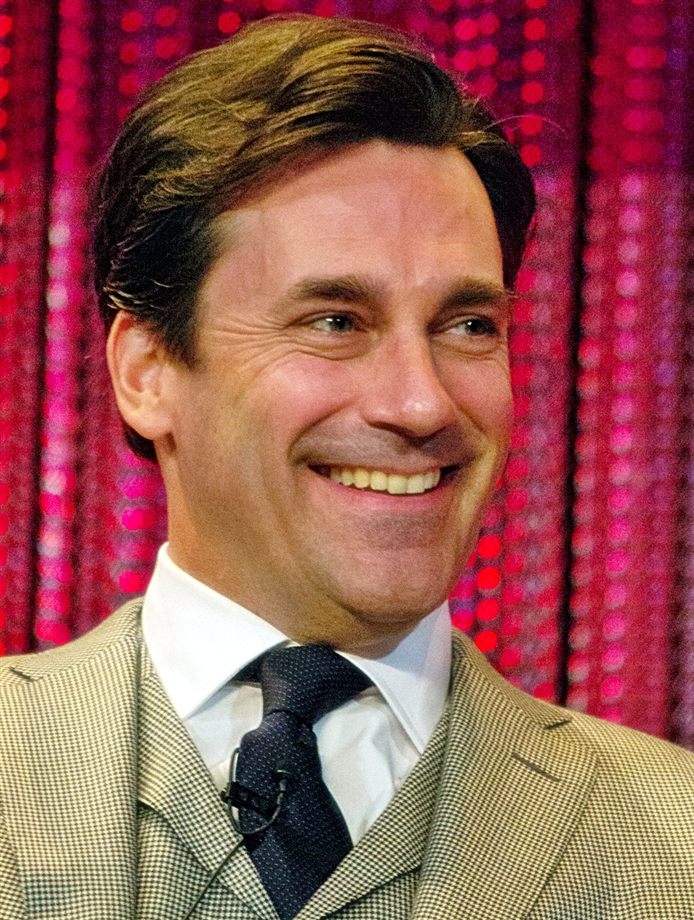
Jon Hamm was born March 10, 1971, in St. Louis, Missouri. He spent years as a working actor — bit parts, guest spots, regional commercials — before landing the role that defined American television in the 2000s: Don Draper in AMC’s Mad Men (2007–2015). As Draper, Hamm played one of the most complex male protagonists in television history: an identity thief, a seducer, a man of devastating competence and equally devastating self-destruction. He received eight Emmy nominations for the role and won on his ninth season, in 2015. He also won the Golden Globe for Best Actor in a Drama Series.
In Landman, Hamm plays Monty Miller, the owner of M-Tex Oil — Tommy’s employer and the man who would be helpless without him. Monty is charming, imperious, and accustomed to authority he hasn’t fully earned. The dynamic between Hamm and Thornton — executive performance versus field expertise, the man who looks like a boss versus the man who actually runs things — is the show’s central class tension, rendered in every scene they share. Hamm is perfectly cast: he knows how to play male authority as a performance concealing something missing underneath.

Born November 11, 1962, in Roswell, New Mexico, Demi Moore became one of the defining film stars of the late 1980s and 1990s. Ghost (1990), A Few Good Men (1992), Indecent Proposal (1993), G.I. Jane (1997) — these were cultural events as much as films, and Moore’s presence in them was central to what made them so. At her peak she was among the most bankable stars in Hollywood, commanding the kind of above-the-title status that very few actors achieve and almost none sustain. Her career in the 2000s was quieter; Landman represents her most substantial television role and a genuine return to prestige drama.
Dallas Miller is Monty’s wife and his social equal in the oil-world hierarchy — which is to say she is not just a trophy but a participant. She navigates their marriage’s complicated arrangements with her own intelligence, her own agenda, and her own understanding of what the arrangement is worth and what it costs her. Moore brings to Dallas the watchfulness of a woman who has been underestimated long enough to have learned to use it. In a show full of men performing authority, Dallas is one of the few characters who doesn’t need to perform anything.

Born February 28, 1976, in Cherry Hill, New Jersey, Ali Larter first broke through in Varsity Blues (1999) and built a steady film career through the early 2000s. She became a television star with Heroes (NBC, 2006–2010), where she played the dual role of Niki Sanders and Tracy Strauss — a performance that required her to distinguish two entirely different characters who shared a face, a challenge she met with more technical precision than the show’s critical reputation might suggest. She continued in the Resident Evil film franchise as Claire Redfield across multiple entries.
In Landman, she plays Angela, Tommy’s ex-wife. The divorce is not clean and the relationship is not finished. Angela has moved forward in ways that Tommy hasn’t fully processed, and the show is honest about what that costs both of them — the particular difficulty of two people who still understand each other completely, which makes everything harder rather than easier. Larter plays the dynamic without sentimentality: Angela is not waiting for Tommy, but she hasn’t stopped noticing him either.

Born March 13, 1996, in Briggsville, Arkansas — a background that is almost too perfect for the role he plays — Jacob Lofland made one of the most impressive acting debuts of the 2010s as Neckbone in Jeff Nichols’s Mud (2012), opposite Matthew McConaughey and Tye Sheridan. His performance as the laconic, self-sufficient river-kid who befriends two runaways was praised as a natural, unforced piece of work that most adult actors could not have managed. Nichols found him through an open casting call in Arkansas; it was his first film.
In Landman, Lofland plays Cooper Norris, Tommy’s son, who works as a derrick hand on the oil rigs — the physically dangerous, economically precarious, working-class ground floor of the same industry his father negotiates from the middle. Cooper is the show’s boots-on-the-ground perspective: the viewer who watches Tommy arrange deals from boardrooms also sees, through Cooper, what those deals look like from the rig floor. His dynamic with Ainsley Miller — the oil baron’s daughter — gives the season one of its sharpest class-collision threads. Lofland’s laconic, unpretentious quality, honed in Mud, is precisely what the role demands.

Michelle Randolph is a younger actress who came to Landman with significant Paramount+ experience already behind her: she appeared in 1883, Taylor Sheridan’s Yellowstone prequel, as Elizabeth Dutton — making Landman her second outing in the Sheridan universe and a sign of the showrunner’s confidence in her range. Born in 1998 in Colorado, she grew up in an acting family; her older sister is actress Ansley Randolph, and her instinct for naturalistic performance suggests she absorbed the craft early.
As Ainsley Miller, the college-aged daughter of Monty and Dallas, Randolph occupies one of the show’s most generationally interesting positions: a young woman who has grown up entirely inside the oil-money world and is beginning to see it from the outside. Her dynamic with Cooper Norris — Tommy’s son, a roughneck on the rig floor — is the season’s most explicit class-collision storyline: two young people who meet on the same patch of West Texas ground coming from opposite ends of the economic order that land has produced.

Canadian actress Kayla Wallace built her profile through a series of television roles before landing Landman. She appeared in When Calls the Heart (Hallmark Channel), where she played Fiona Miller across multiple seasons — a sustained regular role that demonstrated her ability to carry recurring dramatic weight in a long-running series. Her presence in Landman represents a step into the major-network prestige tier.
As Cami, a land negotiation associate who works alongside Tommy, Wallace plays a character embedded in the professional world of the landman operation — someone who understands the business Tommy runs, which is a different relationship to the industry than any other character in the show enjoys. Where Cooper sees the Permian from the rig floor, and Monty sees it from the boardroom, Cami sees it from the deal table, and the show uses her perspective to illuminate the middle-ground mechanics of how leases are made, broken, and renegotiated.
A Cast Built for the Material
Billy Bob Thornton: Wikimedia Commons • CC BY-SA 3.0 • Hollywood Walk of Fame ceremony, February 2012
Jon Hamm: Wikimedia Commons • CC BY-SA • PaleyFest 2014
Demi Moore: Wikimedia Commons • CC BY 3.0 • Photo: Roland Godefroy
Ali Larter: Wikimedia Commons • CC BY 2.5